Arthritis affects over 350 million people worldwide. “Arthritis” is not a single condition — it encompasses more than 100 joint disorders. The two most commonly searched are osteoarthritis (OA), driven by cartilage wear and localised inflammation, and rheumatoid arthritis (RA), an autoimmune condition attacking the joint lining. The evidence for red light therapy differs substantially between the two — and within OA itself, the evidence and protocols differ between knee, hand, hip, and spine. This page is the umbrella: an overview of the science across types, with links to the dedicated guide for each.
Key takeaways
- Jump straight to the dedicated guide for your specific condition — each one covers the relevant clinical evidence, application protocol, and what to expect.
- Red light therapy — formally known as photobiomodulation (PBM) or low-level laser therapy (LLLT) — uses specific wavelengths of light (660nm and 808nm) to penetrate joint tissue and stimulate cellular repair mechanisms.
- Osteoarthritis is characterised by progressive cartilage degradation, bone remodelling, and chronic joint inflammation.
- The evidence base for red light therapy in osteoarthritis is substantial.
Find Your Arthritis Type
Jump straight to the dedicated guide for your specific condition — each one covers the relevant clinical evidence, application protocol, and what to expect.
Also relevant: post-knee-replacement recovery · piriformis & deep gluteal pain · gluteal tendinopathy · tendinopathy
What Is Red Light Therapy and How Does It Work?
Red light therapy — formally known as photobiomodulation (PBM) or low-level laser therapy (LLLT) — uses specific wavelengths of light (660nm and 808nm) to penetrate joint tissue and stimulate cellular repair mechanisms. The light is absorbed by mitochondria in target cells, increasing ATP production, reducing oxidative stress, and suppressing pro-inflammatory cytokines. In the context of arthritis, this translates into three clinically relevant effects:
- Pain modulation: Reduced prostaglandin synthesis and modulation of nociceptive nerve endings
- Inflammation control: Downregulation of TNF-α, IL-1β, and IL-6 at the joint level
- Tissue support: Stimulation of chondrocyte activity and collagen synthesis in the joint capsule
These mechanisms are not speculative — they have been demonstrated in both in-vitro studies and confirmed indirectly through the clinical trial outcomes reviewed below. What differs between OA and RA is how well the clinical evidence reflects these mechanisms in practice.
Two Types of Arthritis: Why Evidence Differs
Osteoarthritis is characterised by progressive cartilage degradation, bone remodelling, and chronic joint inflammation. It is the most common form of arthritis globally and the type that dominates the research database for red light therapy. The majority of high-quality PBM trials have been conducted in knee OA populations, where the joint is accessible, the disease is well-characterised, and outcomes are easy to measure.
Rheumatoid arthritis is an autoimmune disease in which the immune system attacks the synovial lining of joints, causing systemic inflammation, joint erosion, and progressive disability. The mechanisms are fundamentally different from OA, and the evidence for PBM in RA is both more limited and more mixed. Several large meta-analyses have produced conflicting conclusions, and the most recent (2023) large review found results were not consistently superior to sham treatment.
Understanding this distinction is essential before evaluating any treatment claim related to “arthritis” broadly — including red light therapy.
Osteoarthritis: What the Research Shows
The evidence base for red light therapy in osteoarthritis is substantial. Multiple independent systematic reviews and meta-analyses have now confirmed its clinical benefit, particularly for knee OA — the most prevalent and most studied presentation.
Key Meta-Analyses
A 2023 meta-analysis of 820 patients published in Somatosensory & Motor Research found that red light therapy significantly reduces pain and improves range of motion in knee OA when applied at optimal doses (4–8 J per point, 640–905 nm wavelength) over 10–16 sessions. This dose-optimisation finding is particularly important — it confirms that the specific wavelength and energy density matter, and that the MOVE+'s dual-wavelength output (660nm + 808nm) sits squarely within the evidence window.
Earlier, a landmark 2019 meta-analysis in BMJ Open, analysing 1,063 patients across multiple randomised controlled trials, confirmed that LLLT reduces both pain and disability in knee osteoarthritis when delivered at 4–8 J with 785–860 nm wavelengths. The BMJ Open study is widely cited as one of the most rigorously analysed investigations in this field and forms part of the evidentiary foundation for the MOVE+'s FDA 510(k) clearance.
More recently, a 2024 meta-analysis of 542 patients found that photobiomodulation significantly reduced pain at rest in knee OA (-0.7, 95% CI -1.1 to -0.2). The authors rated the certainty of this evidence as very low, citing unclear-to-high risk of bias across the included studies, and recommended against isolated use pending more rigorous trials.
What OA Research Tells Us About Dosing
The OA literature is unusually specific about dosing parameters. Studies consistently point to:
- Wavelengths between 640nm and 905nm (red and near-infrared range)
- Energy densities of 4–8 joules per treatment point
- Session frequency of 2–5 times per week
- Treatment duration of 10–16 sessions (5–8 weeks) for primary benefit
For hip arthritis, shoulder OA, and hand arthritis, the evidence is less voluminous but mechanistically consistent with knee OA findings. Red light therapy for knee osteoarthritis specifically is covered in depth in a separate guide.
Try MOVE+ for Joint Pain Support
FDA 510(k) cleared · 660nm + 808nm wavelengths · 30-days free trial
Explore MOVE+ →Rheumatoid Arthritis: A More Mixed Picture
The evidence for red light therapy in rheumatoid arthritis is more nuanced and requires honest framing. Earlier research produced encouraging results, but the most recent large meta-analysis paints a less definitive picture.
Earlier Supporting Evidence
A 2000 meta-analysis of 454 patients in the Journal of Rheumatology found that LLLT should be considered for short-term relief of pain and morning stiffness in rheumatoid arthritis. The same analysis found no significant pain benefit for osteoarthritis, with conflicting results depending on application method. It cited a favourable safety profile and consistent benefit across the studies included. This finding held up in subsequent reviews through the early 2010s.
What the Most Recent Evidence Shows
A 2023 meta-analysis of 793 patients published in PLOS ONE found that infrared laser therapy may not be consistently superior to sham treatment in RA populations. This is the most current large meta-analytic assessment of PBM in RA and should be taken seriously in any clinical discussion.
The likely explanation lies in the fundamental difference between OA and RA pathophysiology. OA is primarily a localised joint condition — accessible to targeted photobiomodulation. RA is a systemic autoimmune disease in which joint inflammation is driven by immune dysregulation that PBM cannot modulate at a systemic level. Any benefit observed in RA trials is therefore likely to be local and symptom-directed rather than disease-modifying.
Important Note for RA Patients
- Red light therapy is not a substitute for prescribed disease-modifying anti-rheumatic drugs (DMARDs), biologics, or other RA medications.
- If you are currently on methotrexate, leflunomide, or biological therapies, consult your rheumatologist before adding any new device-based intervention.
- For short-term symptom relief between flares, evidence suggests red light therapy may help with pain and morning stiffness — but this should be discussed with your specialist in the context of your overall disease management plan.
How to Use MOVE+ for Arthritis
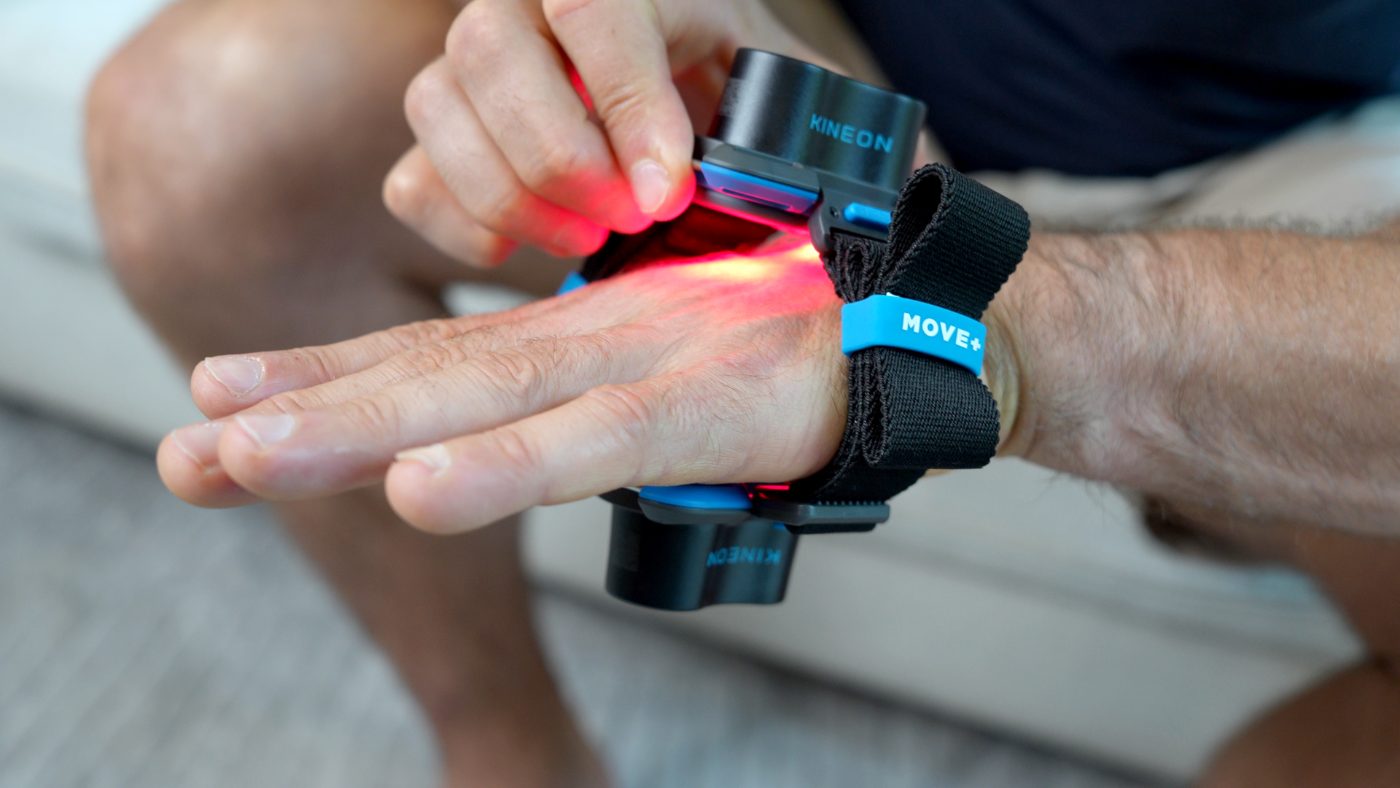
The MOVE+ is designed to deliver targeted photobiomodulation to specific joint areas using a flexible, wearable wrap. For arthritis management, placement depends on the affected joint:
- Knee arthritis: Wrap securely around the knee joint, positioning emitters over the medial and lateral joint line
- Hip arthritis: Position over the lateral hip, targeting the greater trochanter and hip capsule area
- Shoulder OA: Wrap around the anterior and posterior shoulder, covering the glenohumeral joint
- Hand or wrist arthritis: Use targeted spot treatment over the affected finger joints or wrist
Recommended Session Parameters
- Session length: 10–15 minutes per joint area
- Frequency: 5 times per week for the first 8 weeks; maintenance of 3× per week thereafter
- Wavelengths: 660nm (red) + 808nm (near-infrared) — both included in MOVE+
Note: These parameters reflect the dosing ranges used in the clinical studies reviewed above. Individual use should be guided by your healthcare provider, particularly if you have RA or are on prescribed medication.
What to Expect: A Realistic Timeline
Based on the treatment protocols used in the clinical studies cited on this page, a realistic timeline for OA patients looks like this:
- Weeks 1–2: Some patients report reduced pain and improved morning stiffness. Results at this stage are variable.
- Weeks 3–5: Most meta-analyses report clinically meaningful pain reduction by session 8–12. Range of motion improvements typically begin in this window.
- Weeks 6–8: Full therapeutic benefit across the studies reviewed. Function scores (WOMAC, VAS pain) show statistically significant improvement at this point in most trials.
- Beyond 8 weeks: Maintenance therapy (3× per week) may sustain benefit. Some studies suggest continued improvement for up to 12 weeks.
It is important to note that red light therapy does not reverse articular cartilage degeneration in established OA. Its primary documented effects are pain reduction, inflammation control, and functional improvement — meaningful outcomes for quality of life and physical function, but distinct from disease modification.
Is Red Light Therapy Safe for Arthritis?
Across the clinical trials reviewed, red light therapy has a strong safety record. No serious adverse events attributable to PBM have been reported in any of the major meta-analyses. Side effects, when noted, are minor and transient — occasionally including mild local warmth or temporary skin redness at the treatment site.
Specific considerations for arthritis patients:
- Do not use directly over active skin infections or open wounds near the joint
- Avoid use over areas with known malignancy or suspected malignancy without specialist clearance
- If you are photosensitive due to medication (some DMARDs and NSAIDs increase photosensitivity), consult your prescribing physician
- Red light therapy at the therapeutic doses used in these studies does not produce heat sufficient to cause thermal tissue damage
The MOVE+'s FDA 510(k) clearance includes review of safety data. Full device contraindications are available at getkineon.com.
Frequently Asked Questions
For osteoarthritis — yes, with strong evidence. Multiple meta-analyses including a 2019 BMJ Open study of 1,063 patients confirm that red light therapy reduces pain and improves function in OA. For rheumatoid arthritis, the evidence is more mixed: older research supports short-term pain and stiffness relief, but a 2023 meta-analysis of 793 patients found results were not consistently superior to sham. The page above explains this split in detail.
The research protocols that show the strongest results typically use 2–5 sessions per week for 8–16 sessions (5–8 weeks). A common starting point is 5 sessions per week for the first 8 weeks, then 3 sessions per week as maintenance. Sessions are 10–15 minutes per treatment area.
Consult your rheumatologist before adding red light therapy to your treatment plan if you are on methotrexate, leflunomide, or biological therapies. Some DMARDs can increase photosensitivity. Red light therapy is not a substitute for prescribed RA medication and should not be used to replace any aspect of your disease management programme without medical guidance.
Osteoarthritis has a much stronger and more consistent evidence base for red light therapy. The OA research includes multiple large meta-analyses with high effect sizes for pain reduction. RA evidence is more limited and more mixed — the most recent large meta-analysis (2023, N=793) found inconsistent results. This is likely because OA is primarily a localised joint condition that PBM can target directly, while RA is a systemic autoimmune disease that requires systemic treatment.
Key Referenced Researchers
The studies cited in this article were authored by recognised leaders in photobiomodulation research. Below is a brief overview of the principal investigators whose work forms the evidence base for this guide.
Dr. Brosseau holds the University of Ottawa Research Chair in Evidence-Based Practice in Rehabilitation and is a member of the Cochrane Musculoskeletal Group. Her meta-analyses on low-level laser therapy for osteoarthritis and rheumatoid arthritis — including multiple Cochrane reviews — are foundational references in rheumatology and rehabilitation medicine.
View publications →Dr. Hamblin is one of the world's foremost authorities on photobiomodulation, with over 720 peer-reviewed publications, an h-index of 143, and more than 80,000 citations. As Principal Investigator at the Wellman Center for Photomedicine, Massachusetts General Hospital, his research established the foundational cellular mechanisms by which red and near-infrared light modulates inflammation, accelerates tissue repair, and supports neural recovery.
View publications →