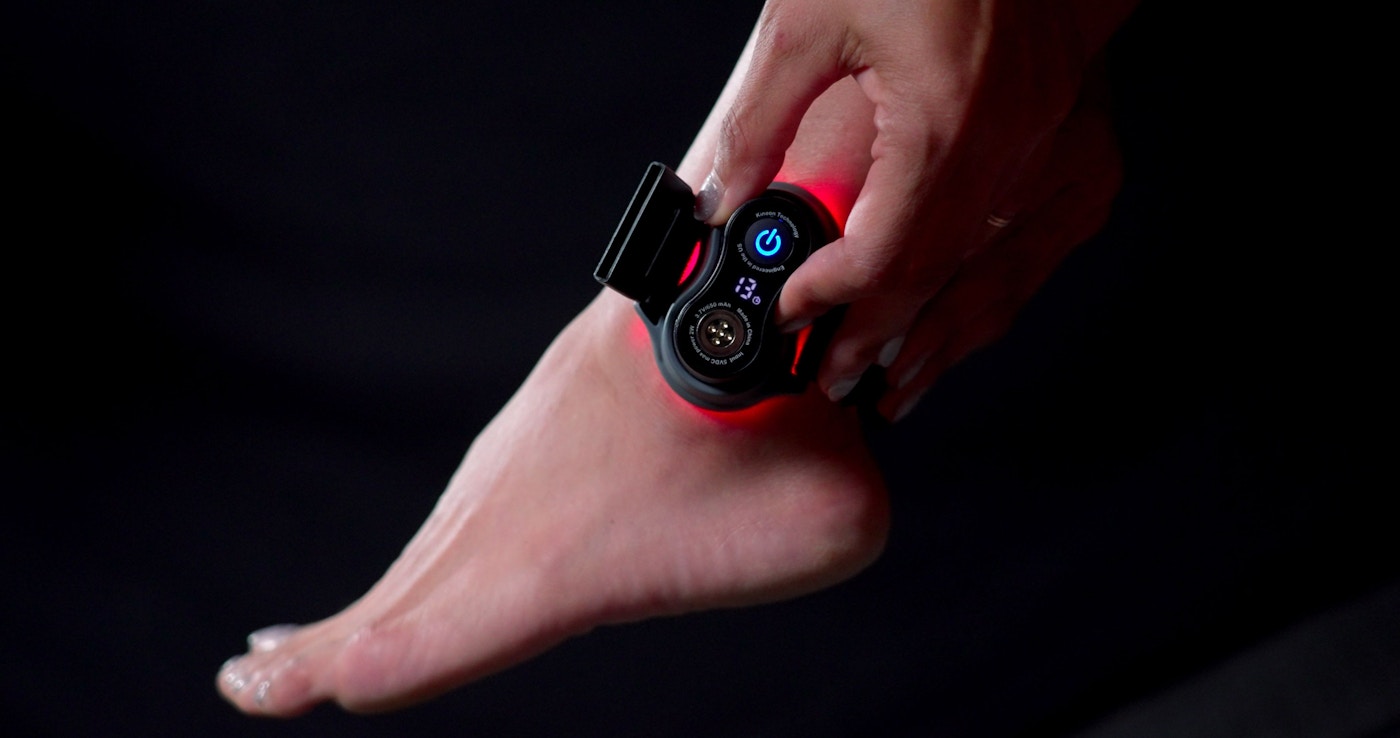
If you have burning pain in your feet at night, tingling that won't quit in your hands, or numbness that's gradually replacing normal sensation — you're describing the three core symptoms of peripheral neuropathy. Roughly 20 million Americans live with it. For most, the standard medical options are gabapentin, pregabalin, or duloxetine — drugs that reduce signal transmission in over-firing nerves but don't address the underlying nerve damage and come with their own side-effect profile.
Red light therapy takes a different angle. Rather than dampening the pain signal, near-infrared photobiomodulation at 808 nm targets the cellular machinery inside the damaged nerve — the mitochondria — and may support genuine nerve regeneration. The 2025 evidence base is the strongest it's ever been for this approach. This guide walks through what the science currently shows, which forms of neuropathy respond best, and how to use the MOVE+ as part of a multimodal approach (never as a replacement for medical care).
Jump to your situation
Diabetic neuropathy (DPN) — the most common form, with the deepest LLLT evidence base. · Chemotherapy-induced neuropathy (CIPN) — emerging evidence for nerve recovery post-treatment. · Idiopathic neuropathy — when no cause is identified. · How to use the MOVE+
Key takeaways
- Peripheral neuropathy often involves damaged or inflamed nerve fibers, leading to miscommunications in pain signaling and reduced nerve function.
- The evidence for red light therapy in neuropathy is growing, with recent systematic reviews and clinical trials supporting its potential as an adjunctive treatment.
- Red light therapy doesn't perform equally across all neuropathy types.
- The MOVE+ is an FDA 510(k) cleared wearable red light therapy device designed to deliver therapeutic wavelengths directly to affected areas.
How Red Light Therapy Affects Nerve Tissue
Peripheral neuropathy often involves damaged or inflamed nerve fibers, leading to miscommunications in pain signaling and reduced nerve function. Photobiomodulation (PBM)—the biological effect of red and near-infrared light—works at the cellular level to address these issues.
The underlying cellular process is the same across every condition on this site — see How Photobiomodulation Works at the Cellular Level for the full mechanism, including what the evidence does and does not establish.
When light at wavelengths between 600–1100 nanometers penetrates tissue, it stimulates mitochondria in nerve cells. Specifically, photons interact with cytochrome c oxidase in the electron transport chain, enhancing ATP (cellular energy) production. More ATP means nerve cells can better repair damage, reduce inflammation, and restore normal signaling. Research shows that near-infrared wavelengths at 808nm demonstrate particular nerve regeneration potential in peripheral neuropathy.
Additionally, PBM reduces inflammatory markers like TNF-α and IL-6, which are often elevated in neuropathic conditions. By lowering inflammation and increasing cellular energy, red light therapy addresses two key mechanisms underlying neuropathic pain.
What the Research Is Finding
The evidence for red light therapy in neuropathy is growing, with recent systematic reviews and clinical trials supporting its potential as an adjunctive treatment. A 2025 evidence-based consensus statement noted that photobiomodulation shows promising results for neuropathic pain management as an adjunctive therapy.
A comprehensive systematic review from 2025 found that near-infrared wavelengths at 808nm demonstrate nerve regeneration potential in peripheral neuropathy. Studies typically assess outcomes like pain reduction (VAS scale), nerve conduction velocity, and sensory perception—and many report improvements after 4–12 weeks of consistent therapy.
Important note: This is an emerging area of research. While results are encouraging, red light therapy should never replace medical diagnosis and treatment. If you have signs of neuropathy, your first step should be a consultation with your physician or neurologist to rule out serious underlying conditions.
Types of Neuropathy and Where the Evidence Is Strongest
Red light therapy doesn't perform equally across all neuropathy types. The mechanism — supporting mitochondrial function in damaged nerves — is universal, but the evidence base and clinical fit vary substantially by cause.
Diabetic Peripheral Neuropathy (DPN)
By far the most common form of neuropathy — affecting roughly half of all people with type 2 diabetes over time. DPN damages nerve fibres through chronic hyperglycaemia, microvascular dysfunction, and inflammatory cascades. Symptoms typically start in the toes and feet and progress proximally over years.
This is also where photobiomodulation has its strongest neuropathy evidence. The mechanism — restoring mitochondrial ATP production, reducing TNF-α and IL-6, supporting microvascular function — maps directly onto the cellular drivers of DPN. Multiple small RCTs and the 2025 systematic review suggest 808 nm NIR over the affected feet (10–20 min, 3–5×/week, 8–12 weeks) can reduce pain scores and may improve nerve conduction velocity. Critical caveat: DPN often involves reduced sensation, so heat-monitoring is essential. Always confirm with your endocrinologist before starting.
Chemotherapy-Induced Peripheral Neuropathy (CIPN)
Platinum-based and taxane chemotherapy agents cause nerve damage as a dose-limiting side effect in 30–70% of patients, depending on the regimen. CIPN often persists long after chemo ends, and there are very few effective treatments — duloxetine has the strongest evidence among medications, but its effect size is modest.
Photobiomodulation is one of the most promising emerging options. Several pilot RCTs in cancer survivors have shown reductions in numbness, tingling, and pain following PBM protocols, and the underlying mechanism (mitochondrial recovery) is biologically plausible because chemo neurotoxicity is fundamentally a mitochondrial injury. Critical caveat: Always coordinate with your oncology team before starting — never apply over recent radiotherapy fields or active malignancy sites.
Idiopathic Peripheral Neuropathy
"Idiopathic" means the cause hasn't been identified despite a workup — between 15% and 30% of neuropathy cases sit here. Photobiomodulation's broad mechanism (inflammation reduction, ATP support, microvascular and neural function) means it can still be a useful adjunct, but the evidence is less direct because trial populations have typically been characterised by cause (DPN, CIPN) rather than by exclusion.
Traumatic Nerve Injury
Neuropathy from acute injury (accident, surgery, compression) is a different beast — the nerve has structural damage that may or may not heal. Photobiomodulation has the strongest basic-science evidence here (animal studies clearly show accelerated nerve regeneration with NIR). Translation to clinical practice requires close coordination with a neurologist or surgeon, particularly to confirm there's no progressive deficit needing surgical decompression.
The evidence is strongest for mild-to-moderate neuropathy. Severe cases with significant nerve loss should be evaluated medically before considering PBM as an adjunct.
Using the MOVE+ for Nerve Pain
The MOVE+ is an FDA 510(k) cleared wearable red light therapy device designed to deliver therapeutic wavelengths directly to affected areas. For neuropathy, here's how to use it effectively:
- Target Area: Apply the MOVE+ over the affected area (hands, feet, legs, arms). For diabetic neuropathy, feet are the most common site.
- Duration: Start with 15–20 minute sessions, 5 days per week. After 2–3 weeks, you may extend to 30 minutes if well-tolerated.
- Timeline: Expect to assess benefit after 4–8 weeks of consistent use. Some individuals report initial changes in tingling or pain sensitivity within 2–3 weeks.
- Consistency: Adherence is critical. Red light therapy works best with regular application, not sporadic use.
- Safety Considerations: For diabetic neuropathy, ensure normal sensation in the treatment area. If you have reduced feeling, monitor carefully to avoid excessive heat exposure.
Always discuss your specific neuropathy type and severity with your doctor before starting any red light therapy protocol. Your physician can help tailor use to your individual needs and monitor for any interactions with medications or other treatments.
Safety Considerations for Neuropathy
Red light therapy is generally well-tolerated, but neuropathy patients have special considerations. Nerve damage often reduces sensation, making it harder to detect excessive heat or irritation. Follow these guidelines:
- Start with shorter sessions (5–10 minutes) and gradually increase.
- Do not apply the device over areas with open wounds, active infection, or severe skin conditions.
- For diabetic neuropathy, check the treatment site regularly after each session for any signs of irritation.
- If you have been diagnosed with severe neuropathy or nerve damage, consult your neurologist or endocrinologist before beginning red light therapy.
Red light therapy is not a replacement for medical neuropathy management. Use it as an adjunctive tool alongside your prescribed medications, physical therapy, and lifestyle modifications.
Drug-Free Support for Nerve Pain — Backed by Emerging Research
While research on red light therapy for neuropathy continues to grow, the evidence for its safety and potential effectiveness is encouraging. The MOVE+ offers a wearable, evidence-based approach to adjunctive neuropathy care—integrated into your daily routine.
Explore MOVE+Frequently Asked Questions
Safety Considerations for Neuropathy
- Diabetic neuropathy: Reduced sensation may affect awareness of device heat; consult your endocrinologist before use
- Active infection or open wound: Do not apply the device over these areas
- Severe nerve damage: Medical assessment required first to rule out contraindications
- Medication interactions: Inform your doctor of all medications; some may increase photosensitivity
- Not a replacement: Red light therapy should not replace prescribed neuropathy medications or medical treatment