After ACL reconstruction, most athletes face 9–12 months of recovery. Research shows red light therapy can support that recovery — reducing post-surgical pain, swelling, and improving range of motion in the critical early weeks. A 2026 meta-analysis of 4,920 patients confirmed near-infrared light enhances postoperative healing. Here's what the evidence supports and how to use it during ACL rehab.
Key takeaways
- Yes, for recovery outcomes — specifically pain reduction, swelling management, and range of motion restoration.
- The primary evidence for post-ACL recovery comes from studies on knee surgery recovery generally.
- Red light therapy can be initiated in the early post-surgical period once wound closure is confirmed and the surgical incision has begun healing (typically day 3–5 post-op, pending surgeon clearance).
- The MOVE+ 2.0 is FDA 510(k) cleared and specifically designed as a knee-wearable, making it well-suited for daily ACL recovery protocols.
Can Red Light Therapy Help After ACL Surgery?
Yes, for recovery outcomes — specifically pain reduction, swelling management, and range of motion restoration. Research shows red light therapy supports post-surgical recovery through its effects on inflammation, cellular energy production, and tissue repair signalling. A 2026 meta-analysis of 4,920 surgical patients found near-infrared therapy demonstrates promise for enhancing postoperative healing and reducing pain after surgery (PMID 41605843).
The underlying cellular process is the same across every condition on this site — see How Photobiomodulation Works at the Cellular Level for the full mechanism, including what the evidence does and does not establish.
Note on tissue claims: Recovery outcomes (pain, swelling, range of motion) are supported by Tier 1 evidence and used with direct language below. Claims about ACL ligament regeneration or tissue healing at the reconstruction site are early-stage research and framed as preliminary where relevant.
What the Evidence Supports
Post-Surgical Pain and Swelling Reduction (Tier 1)
The primary evidence for post-ACL recovery comes from studies on knee surgery recovery generally. A 2026 scoping review specifically examining photobiomodulation after total knee arthroplasty (TKA) — a directly analogous post-surgical knee context — found: "PBM reduces pain and swelling and improves knee flexion, ROM and function in the immediate postsurgical period." (PMID 41340729)
An RCT (N=45, PMID 36507283) confirmed that LLLT reduced swelling and opioid requirements while improving range of motion and functional scores in early knee surgery recovery. Reduced opioid dependence during ACL recovery is clinically significant — opioid use after ACL reconstruction is associated with slower return-to-sport and increased re-injury risk.
The mechanism: 850nm NIR penetrates to the surgical site where it reduces neutrophil-mediated inflammation in the acute post-surgical phase (days 1–7), then shifts to support macrophage-driven tissue repair and fibroblast collagen synthesis in the subacute phase (weeks 2–8).
Restoring Range of Motion (Tier 1)
Regaining full knee flexion and extension is a primary milestone in ACL recovery and a prerequisite for return to sport. Research shows photobiomodulation improves knee flexion ROM in the post-surgical period, with the 2026 scoping review (PMID 41340729) specifically documenting improved knee flexion as a primary outcome. The mechanism involves reduced capsular adhesion formation, reduced muscle guarding secondary to pain reduction, and direct effects on connective tissue extensibility.
Early ROM restoration also reduces the risk of arthrofibrosis — a serious complication of ACL reconstruction in which excessive scar tissue formation limits knee movement permanently. Regular LLLT during the first 6 weeks post-surgery may help prevent the inflammatory cascade that leads to arthrofibrosis.
Tissue Healing — Early-Stage Research (Tier 3)
Scientists are investigating whether red light therapy can directly support ACL graft healing and ligament tissue regeneration. An in vitro study using rabbit ACL cells (PMID 23615758) found red LED (630nm) stimulated fibroblast proliferation and collagen production in ACL cell cultures. This is preliminary, cell-culture research — it does not confirm the same effects occur in a reconstructed human ACL graft in vivo. Framing this as proven tissue healing would not be accurate.
The practical takeaway: use LLLT for its well-evidenced recovery benefits (pain, swelling, ROM), and view the tissue-level research as early-stage supporting evidence for its mechanism.
FDA 510(k) Cleared · 660nm + 808nm
Try MOVE+ 2.0 Risk-Free for 30 Days
Shop MOVE+ 2.0 — $49930-day money-back guarantee
How to Use Red Light Therapy During ACL Recovery
When to Start (Post-Op Timeline)
Red light therapy can be initiated in the early post-surgical period once wound closure is confirmed and the surgical incision has begun healing (typically day 3–5 post-op, pending surgeon clearance). Apply around — not directly over — the surgical incisions during the first 2 weeks. After 2 weeks, the device can be positioned directly over the knee.
- Week 0–2 post-op: Apply to periarticular knee, avoiding incision sites. 10 min per session, once daily.
- Weeks 2–8: Full coverage of the anterior knee. 15–20 min per session, once or twice daily.
- Weeks 8–24: Maintenance 3–4× per week alongside physiotherapy programme.
Treatment Protocol (660nm + 808nm, duration, frequency)
- Wavelengths: 660nm (anti-inflammatory, superficial) + 808nm (deep tissue penetration) — the MOVE+ 2.0 delivers both
- Session duration: 15–20 minutes
- Frequency: Daily during active rehab phases; use around physiotherapy sessions for best results
- Always confirm: Get surgeon sign-off before starting any post-surgical recovery protocol
MOVE+ 2.0 Placement for the Knee Post-Surgery
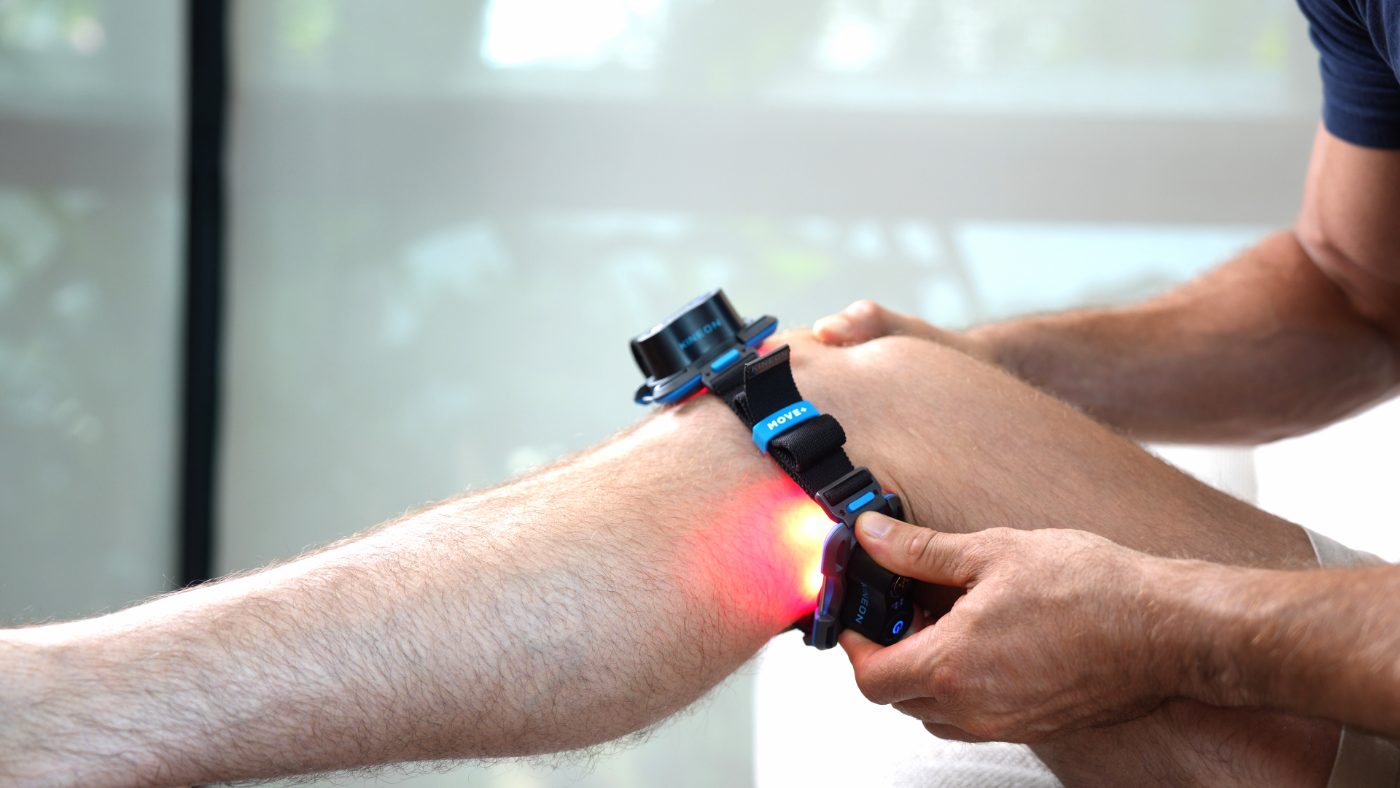
Wrap the MOVE+ 2.0 band around the anterior knee, with diodes centred on the patellar tendon and medial/lateral joint lines. For quadriceps swelling reduction, extend placement to the distal quadriceps muscle belly. After the first 2 weeks, the device can be worn directly over the ACL reconstruction site for maximum light delivery to the healing tissue.
The MOVE+ 2.0 for ACL Recovery
The MOVE+ 2.0 is FDA 510(k) cleared and specifically designed as a knee-wearable, making it well-suited for daily ACL recovery protocols. Its wearable format means treatment sessions can be completed during other rehabilitation activities — ice application, elevation, or passive range of motion exercises — without requiring dedicated stationary time.
Related reading: red light therapy for knee pain · red light therapy for back pain · how photobiomodulation works
FDA 510(k) Cleared · 660nm + 808nm
Try MOVE+ 2.0 Risk-Free for 30 Days
Shop MOVE+ 2.0 — $49930-day money-back guarantee