Key takeaways
- Red light therapy — also called photobiomodulation (PBM) or low-level laser therapy (LLLT) — uses specific wavelengths of light, typically 660nm (red) and 808nm (near-infrared), to penetrate soft tissue and stimulate cellular repair.
- The evidence base for red light therapy in ankle sprain recovery has strengthened considerably.
- The 2024 meta-analysis found high effect sizes specifically for pain intensity reduction — exceeding the benchmarks typically used for NSAID comparisons in sports injury research.
- Beyond pain and swelling, a body of supporting research suggests that photobiomodulation may influence the underlying inflammatory and tissue-repair processes involved in ankle sprain recovery.
What Is Red Light Therapy?
Red light therapy — also called photobiomodulation (PBM) or low-level laser therapy (LLLT) — uses specific wavelengths of light, typically 660nm (red) and 808nm (near-infrared), to penetrate soft tissue and stimulate cellular repair. At the cellular level, light energy is absorbed by mitochondria, boosting ATP production and triggering an anti-inflammatory cascade that reduces swelling, accelerates tissue healing, and modulates pain signalling. Unlike topical gels or compression alone, photobiomodulation works at the site of injury itself — targeting the ligamentous and soft tissue damage that defines a sprained ankle.
The underlying cellular process is the same across every condition on this site — see How Photobiomodulation Works at the Cellular Level for the full mechanism, including what the evidence does and does not establish.
What the Research Says About Ankle Sprain Recovery
The evidence base for red light therapy in ankle sprain recovery has strengthened considerably. The most comprehensive evaluation to date is a 2024 systematic review and meta-analysis of 598 patients, published in Lasers in Medical Science, which concluded that photobiomodulation therapy showed a high effect size with a moderate level of evidence on pain intensity in ankle sprain recovery. This is one of the strongest effect sizes reported for any conservative ankle sprain intervention. The same analysis found a non-significant effect on oedema and only a low effect size on function, so the evidence is strongest for pain and more limited for swelling and functional recovery.
The authors evaluated multiple PBM parameters — wavelength, dose, application timing — and found consistent benefits across study populations that included both acute and subacute presentations. For athletes and active adults looking for non-pharmacological recovery support, this represents a meaningful clinical signal.
Pain and Swelling: Two Key Targets
Reducing Pain Intensity
The 2024 meta-analysis found high effect sizes specifically for pain intensity reduction — exceeding the benchmarks typically used for NSAID comparisons in sports injury research. Photobiomodulation modulates nociception through multiple pathways: reducing the local prostaglandin load, inhibiting substance P release, and promoting endorphin-mediated pain suppression. The net result is meaningful, measurable pain relief that begins within the first few sessions.
Controlling Oedema and Swelling
An earlier randomised controlled trial of 47 patients found that red light therapy, when applied alongside the standard RICE protocol, significantly reduced oedema in Grade II ankle sprains. Swelling control is critical in the acute phase — excessive oedema delays ligament remodelling, prolongs immobility, and increases the risk of chronic ankle instability if the joint is returned to load prematurely.
Evidence Suggests: Inflammation Modulation
Beyond pain and swelling, a body of supporting research suggests that photobiomodulation may influence the underlying inflammatory and tissue-repair processes involved in ankle sprain recovery. Evidence from clinical studies indicates that PBM may:
- Reduce pro-inflammatory cytokine expression (IL-1β, TNF-α) at the injury site
- Accelerate collagen synthesis in stretched and torn ligament fibres
- Improve ankle function scores in Grade II sprains when applied within the first 72 hours
- Support return-to-sport outcomes when combined with standard physiotherapy
These findings are drawn from Tier 2 studies — well-designed human trials that use qualified language. The mechanistic evidence is consistent and the clinical plausibility is strong, though this body of research has not yet reached the same meta-analytic weight as the primary pain outcome data.
How to Use MOVE+ for Ankle Sprain
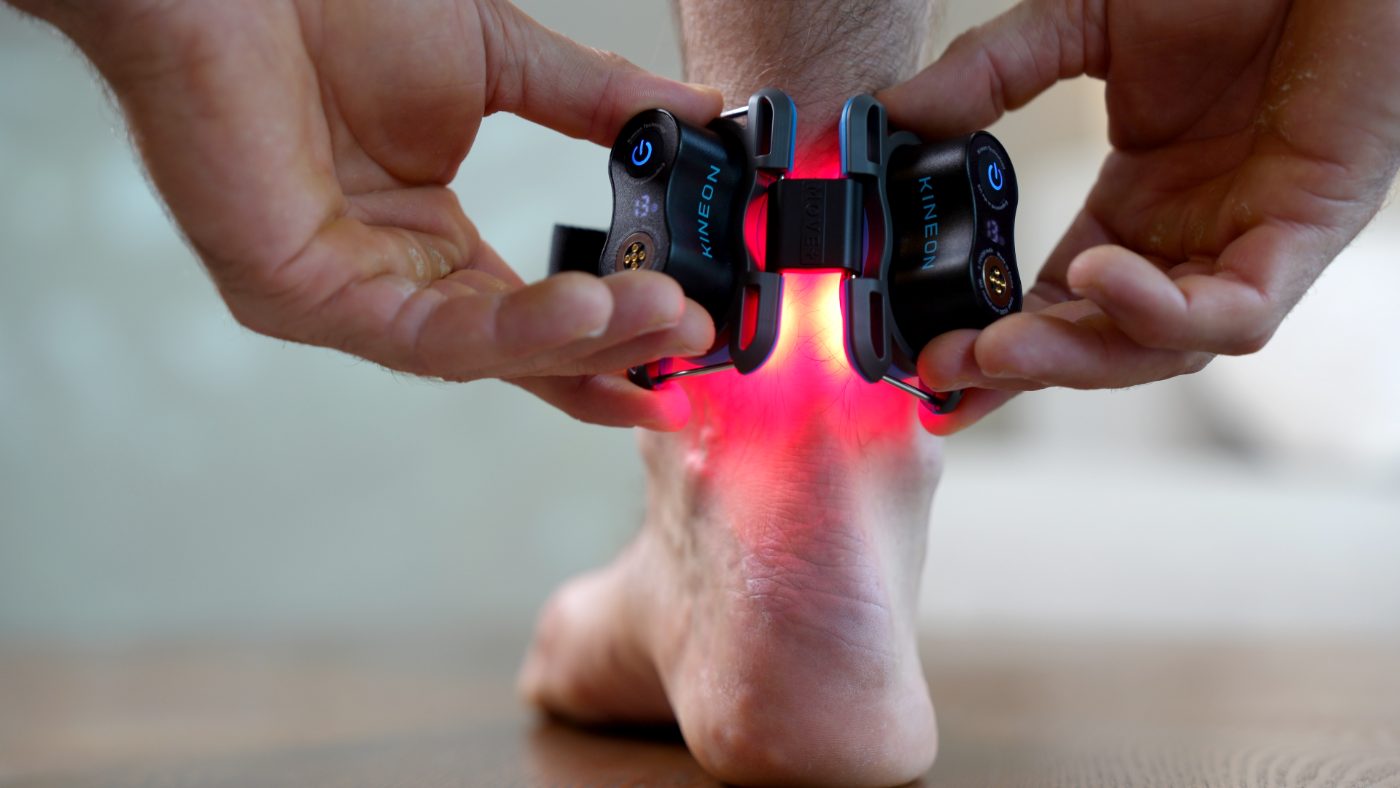
The MOVE+ uses dual-wavelength output (660nm + 808nm) to deliver therapeutic photobiomodulation to the ankle joint. The wearable design wraps around the ankle, positioning light emitters over the medial and lateral malleolus — the primary sites of soft tissue injury in most Grade I and II sprains.
Recommended Protocol
- Frequency: Once daily in the first week; 5× per week thereafter
- Session length: 10 minutes per session in the acute phase (days 1–7)
- Placement: Wrap securely around the ankle, centred over the area of maximal tenderness — typically the anterior talofibular ligament (ATFL)
- Phase: Begin as soon as the skin is intact and no fracture has been ruled out — typically 24–48 hours post-injury
- Duration: Continue for 4–6 weeks, adjusting as symptoms improve and load is reintroduced
Note: The protocol above is based on device specifications and general PBM guidelines. Individual sessions should be guided by your healthcare provider and adjusted based on your injury grade and recovery trajectory.
Support Your Ankle Recovery with MOVE+
FDA 510(k) cleared · 660nm + 808nm wavelengths · Wearable, hands-free design
Try MOVE+ Risk-Free →Who Is Red Light Therapy Suitable For?
Red light therapy is most appropriate for individuals with Grade I and Grade II ankle sprains — the two most common injury classifications, involving stretch or partial tear of the lateral ligaments without significant joint instability. Most recreational and competitive athletes fall into this category.
It is well-suited for the post-acute phase (after the initial 24–48 hours) through return-to-sport rehabilitation — the period in which reducing residual pain and swelling, restoring range of motion, and rebuilding proprioception are the primary clinical goals.
Important Limitations
- Not suitable for suspected fractures. If you heard a crack at the time of injury, cannot bear weight, or have point tenderness over the fibula or fifth metatarsal, seek medical assessment before using any device on the ankle.
- Grade III ligament tears (complete rupture with joint instability) require orthopaedic evaluation. Red light therapy may still be used as an adjunct if cleared by your surgeon, but it does not replace surgical or immobilisation management.
- Red light therapy is intended as a supportive therapy, not a standalone treatment. Combine with progressive loading, balance training, and physiotherapy-guided rehabilitation for best outcomes.
Frequently Asked Questions
Yes, according to current clinical evidence. A 2024 systematic review and meta-analysis of 598 patients found that photobiomodulation therapy shows a high effect size for reducing pain intensity in ankle sprain recovery — one of the strongest effect sizes reported for a conservative ankle sprain intervention. The evidence is strongest for pain; the same analysis found a non-significant effect on oedema and only a low effect size on function.
Most people notice reduced pain and swelling within the first 3–5 sessions (3–5 days of daily use). Functional improvement — restored range of motion and ability to bear full weight — typically follows over 2–4 weeks depending on the severity of the sprain and overall rehabilitation compliance. Red light therapy accelerates the process but does not replace the progressive loading and balance work needed for full recovery.
We recommend waiting 24–48 hours after the acute injury before starting red light therapy, allowing the initial inflammatory response to stabilise and ensuring the skin is intact. Applying PBM too early (in the first few hours) may theoretically interfere with the acute inflammatory phase, which plays a role in initial tissue repair signalling. After the first 24–48 hours, daily use is appropriate and supported by the clinical evidence.
Evidence suggests photobiomodulation may help manage pain and inflammation associated with chronic ankle instability — a condition where repeated sprains have left the joint permanently weakened. However, chronic instability is a complex biomechanical problem that primarily requires targeted proprioceptive rehabilitation, bracing, and in some cases surgical reconstruction. Red light therapy can be used as a supportive adjunct within a comprehensive management plan.
Key Referenced Researchers
The studies cited in this article were authored by recognised leaders in photobiomodulation research. Below is a brief overview of the principal investigators whose work forms the evidence base for this guide.
Dr. Vuurberg completed her PhD on chronic lateral ankle instability at the University of Amsterdam, in a collaboration between the orthopaedics and radiology departments. She is a lead author on international clinical guidelines for the diagnosis, treatment, and prevention of ankle sprains, affiliated with the Academic Center for Evidence-based Sports Medicine (ACES).
View publications →Dr. Leal-Junior has authored over 140 peer-reviewed publications in photobiomodulation — more randomised controlled trials than any other researcher in the field. His research spans sports performance, muscular fatigue, tendinopathy, and post-exercise recovery. Supported by USD 3M+ in grants, he leads the Laboratory of Phototherapy and Innovative Technologies in Health (LaPIT) in Brazil.
View publications →