Draft — pending clinical review
- This page is drafted to brief and is awaiting Forrest Smith's clinical sign-off before publication.
Herniated discs, degenerative disc disease and bulging discs affect hundreds of millions of people worldwide. Red light therapy targets inflammation and pain signalling in the disc and the surrounding tissue. This guide sets out what the clinical evidence shows — including where it supports treatment and where it does not.
What disc disease is and why it is hard to treat
Three related conditions sit under the discogenic umbrella, and they differ in structure more than in symptom:
- Herniated disc — the nucleus pulposus protrudes through the annulus fibrosus and can compress nerve roots.
- Degenerative disc disease — age-related loss of disc hydration and height, accompanied by chronic inflammation.
- Bulging disc — the disc extends beyond its normal perimeter without full herniation.
The common thread is disc-level inflammation and neural sensitisation. That shared mechanism is why photobiomodulation is discussed across all three, even though the structural picture differs in each.
How red light therapy works on disc and spinal tissue
The mechanisms relevant to discogenic pain are inflammatory and neurological rather than structural:
- Reduces pro-inflammatory cytokines such as IL-6 and TNF-alpha in the disc and surrounding soft tissue.
- Supports local circulation in the paraspinal area.
- Modulates pain signalling through spinal sensitisation pathways.
- Supports soft tissue recovery in the paraspinal musculature.
An important limit: the evidence does not support direct disc repair or disc regeneration. Nothing in the literature demonstrates that photobiomodulation produces structural change in the disc itself.
Clinical evidence: what the research supports
The strongest evidence base sits with discogenic low back pain rather than with degenerative disc disease as a structural diagnosis.
Evidence supporting benefit
A 2016 systematic review and meta-analysis of 15 randomised controlled trials (N=1,039) by Glazov, Yelland and Emery, published in Acupuncture in Medicine, found moderate-quality evidence (GRADE) supporting a clinically important benefit of low-level laser therapy for chronic non-specific low back pain in the short term (WMD -1.40cm, 95% CI -1.91 to -0.88) (PMID 27207675). The benefit appeared specifically in trials using at least 3 Joules per point, and in patients whose pain was of shorter duration.
A 2022 double-blind randomised controlled trial (N=110, 830nm, 300mW, 3 J, 18 sessions) by Ahmed et al. in the Journal of Healthcare Engineering examined discogenic lumbar radiculopathy — the closest condition match available in the literature to this page. Low-level laser therapy combined with conventional physical therapy significantly improved pain intensity, functional disability and lumbar range of motion compared with physical therapy alone (PMID 35265302). The authors frame it as an adjunct to physical therapy, not a standalone treatment.
A 2020 three-arm randomised controlled trial (N=60, 850nm, 50 J) by Abdelbasset et al. found that both low-level and high-intensity laser therapy significantly improved pain (VAS), disability (Oswestry Disability Index), lumbar range of motion and quality of life in chronic non-specific low back pain, compared with an untreated control group (PMID 33178306). This trial had no sham arm, so a placebo-independent effect cannot be isolated from it alone.
A 2020 sham-controlled randomised controlled trial by Kholoosy et al. (808nm, 12 sessions) reported a reduction in spinal tenderness in low back pain patients receiving treatment (PMID 32273951). The specific response figure from this trial is being confirmed against the full text before publication and is deliberately not quoted here.
Evidence against benefit, included in full
A 2018 placebo-controlled, double-blind randomised controlled trial (N=68) by Taradaj et al. in Clinical Interventions in Aging directly evaluated patients with lumbar disc degenerative changes and concluded that neither high-intensity laser therapy (1,064nm) nor low-level laser therapy (786nm) produced a significant advantage over placebo, in either the short or the long term (PMID 30174418).
This negative result is presented deliberately rather than omitted. The trial compared two protocols against placebo and found no significant difference between them, which leaves open whether the specific wavelength and dose used — rather than the underlying mechanism — explains the outcome. Neither protocol was matched to MOVE+ 2.0 specifications.
How to read this evidence honestly
- Discogenic low back pain: a Tier 1 evidence base exists.
- Degenerative disc disease as a structural diagnosis: evidence is limited, and one well-conducted negative trial exists.
- Herniated disc specifically: evidence is emerging, and only verified studies are cited here.
- Low back pain evidence should not be conflated with structural claims about disc degeneration.
Dosing protocol for disc and spinal pain
- Wavelength — 808nm and 850nm near-infrared.
- Application — directly over the affected spinal segment and the paraspinal muscles.
- Session duration — 10 to 20 minutes.
- Frequency — three to five times per week.
- Typical usage — consistent use across four to eight weeks.
Per-session energy density figures are not published here pending confirmation of the MOVE+ 2.0 product specification.
What red light therapy can and cannot do for disc disease
What the evidence supports: reducing inflammation in the tissue surrounding the disc, reducing pain signalling, and supporting soft tissue recovery alongside conservative treatment.
What it does not support: repairing structural disc damage, reversing disc degeneration, or replacing physical therapy or medical treatment.
MOVE+ 2.0 for disc and spinal pain
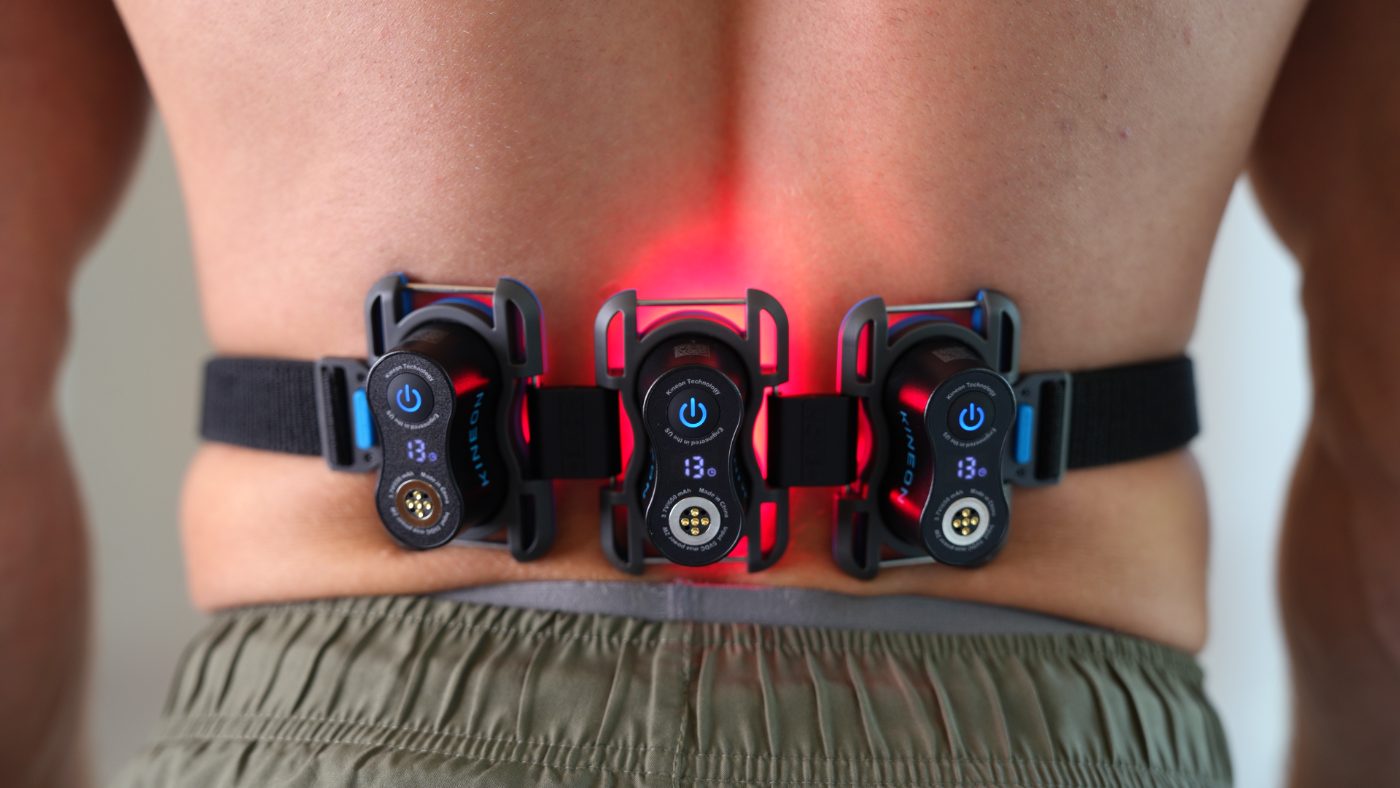
MOVE+ 2.0 is a red light therapy device intended for at-home use over the affected area. Its listed use is to reduce inflammation and to reduce minor joint and muscle pain. Read the clinical evidence above on its own terms — it describes the research literature, not a claim about this device.
See the MOVE+ 2.0 product page for specifications, and the lower back pain guide for the broader back pain evidence base.
Frequently asked questions
Can red light therapy help a herniated disc?
The evidence supports reduced inflammation and reduced pain signalling in discogenic low back pain, with the closest condition match being a trial in discogenic lumbar radiculopathy (PMID 35265302). It does not support repair of the disc itself.
Does red light therapy work for degenerative disc disease?
The honest answer is that the evidence is mixed. Benefit has been shown for pain and inflammation in discogenic back pain, but a placebo-controlled trial in patients with lumbar disc degenerative changes found no significant advantage over placebo (PMID 30174418). There is no broad efficacy claim to make for degenerative disc disease as a structural diagnosis.
How long does red light therapy take to work for disc pain?
Studies typically apply treatment three to five times per week across four to eight weeks. That describes the usage pattern in the literature rather than a promised timeline.
Can red light therapy replace surgery or physical therapy for a herniated disc?
No. The trial with the closest condition match tested it as an adjunct to conventional physical therapy, not as a replacement for it, and not as an alternative to medical treatment.
What should I look for in a device for back and disc pain?
The relevant selection criteria are wavelength in the 808 to 850nm near-infrared range, the ability to apply it directly over the spinal segment, and a form factor that makes consistent use across several weeks realistic.