Draft — pending clinical review
- This page is drafted to brief and is awaiting Forrest Smith's clinical sign-off before publication.
Arthritis affects over 350 million people worldwide. Red light therapy targets joint inflammation and pain signalling. This guide sets out what the clinical evidence shows for osteoarthritis, including where the research is strong, where it is null, and what that difference appears to depend on.
What arthritis is and why it is hard to treat
Osteoarthritis and rheumatoid arthritis arrive by different routes. Osteoarthritis is driven by mechanical wear and progressive cartilage loss; rheumatoid arthritis is an autoimmune process in which the synovium is attacked directly. What they share is chronic inflammation and progressive joint degradation, which is why photobiomodulation has been studied across both.
This page covers osteoarthritis at full strength and rheumatoid arthritis at the weaker level the evidence actually supports.
How red light therapy works on arthritic joints
- Reduces pro-inflammatory cytokines such as IL-6 and TNF-alpha in synovial tissue.
- Supports chondrocyte activity in osteoarthritic cartilage.
- Supports local circulation in the joint area.
- Reduces pain signalling and joint inflammation.
Clinical evidence: osteoarthritis
The knee osteoarthritis laser literature is split, and the split is informative. Presenting only the positive results would misrepresent it.
The two anchor meta-analyses
A 2019 systematic review and meta-analysis by Stausholm et al. in BMJ Open pooled 22 randomised controlled trials (n=1,063) and found pain reduced against placebo by 14.23mm on a 100mm visual analogue scale at the end of therapy (95% CI 7.31 to 21.14), 15.92mm at 1 to 12 week follow-up, and a peak of 31.87mm at 2 to 4 weeks when recommended doses were used (PMID 31662383). Benefit was dose-dependent, appearing at 4 to 8 Joules per spot in the 785 to 860nm range. Disability was significantly reduced and no adverse events were reported.
A 2023 meta-analysis by Malik et al. in Somatosensory and Motor Research pooled 14 randomised controlled trials (n=820) and found pain significantly reduced immediately after therapy (SMD -0.58), at 4 to 8 Joules per point in the 640 to 905nm range across 10 to 16 sessions (PMID 36576096). The same analysis found no significant benefit for range of motion, muscle strength or function against placebo.
Two independent meta-analyses converging on the same 4 to 8 Joule dose window, at wavelengths in the same band, is the most useful line in this literature. Both found a pain benefit; neither found a clear function or range-of-motion benefit. That distinction is worth carrying into any expectation of what treatment does.
The null result, presented alongside
A 2015 meta-analysis by Huang et al. in Osteoarthritis and Cartilage found a pain effect that did not reach significance (SMD -0.28, 95% CI -0.66 to 0.10), and a WOMAC result that likewise did not (SMD -0.25) (PMID 25914044). Read against the two anchor analyses, the most plausible reconciliation is dose: benefit in the positive studies appears only where adequate energy and wavelength were used.
Supporting trials at device-matched wavelengths
A 2020 single-blind, placebo-controlled trial by Vassao et al. in Lasers in Medical Science (n=33, 808nm, 100mW per point, 4 Joules per point, 56 Joules total across 16 sessions) reported a positive outcome direction, attributed to anti-inflammatory effect and mitochondrial energy production (PMID 32157582). No pain-reduction percentage is available in the verified record for this trial and none is quoted here.
A 2021 randomised controlled trial (n=36, 808nm cluster, 91 Joules across 16 sessions) found WOMAC functional capacity increased significantly (p<0.001), with anti-inflammatory IL-10 rising in the photobiomodulation-plus-exercise group while IL-1beta rose in controls (PMID 34656170). The effect here is from photobiomodulation combined with exercise, not from photobiomodulation alone.
A 2022 randomised controlled trial (n=42, 808nm, 10 sessions) found VAS favoured the laser group between groups (p<0.05), while the WOMAC between-group result was not significant (PMID 36313402). This trial used a higher intensity than MOVE+ 2.0 delivers.
A 2017 systematic review and meta-analysis by Rayegani et al. in the Journal of Lasers in Medical Science (~823nm) reported significant benefit on pain at rest, pain on activity, total pain, and WOMAC function and stiffness, and no significant result for WOMAC pain or range of motion (PMID 29071029). Specific outcome figures from this review are withheld pending full-text review.
Clinical evidence: rheumatoid arthritis
Pending clinical sign-off. This section is drafted to brief and has not yet had Forrest Smith's written clinical review. It should not be published to kineon.io until that review is complete.
Rheumatoid arthritis is a different problem from osteoarthritis, and the evidence is weaker. What follows is Tier 2 — smaller studies, less consensus, and results that do not all point the same way. Red light therapy is discussed here strictly as a possible adjunct alongside prescribed medication, never as a replacement for it.
PMID 39574241 — a 2024 systematic review and meta-analysis by Salajegheh et al. in the European Journal of Translational Myology pooled 22 studies and found that low-level laser therapy did not significantly reduce pain compared with placebo (MD 0.00, 95% CI -0.09 to 0.09, p=0.97). It did significantly improve grip strength (MD -12.38, 95% CI -17.42 to -7.34, p<0.01) and reduce morning stiffness (MD -0.84, 95% CI -1.33 to -0.36, p<0.01), though with substantial heterogeneity in both outcomes. The authors position it as an adjunctive treatment and call for further research to optimise protocols.
PMID 37683021 — a 2023 systematic review by Lourinho et al. in PLoS One reached a more sceptical conclusion, stating that infrared laser may not be superior to sham in rheumatoid arthritis patients, and that there is insufficient information to support or refute red laser, laser acupuncture or reflexology for this condition.
Taken together: the more encouraging finding is for function — grip strength and morning stiffness — rather than for pain, and one of the two reviews finds no advantage over sham at all. Anyone reading this should treat rheumatoid arthritis as an open question rather than a settled one, and should not change prescribed medication on the basis of it.
Dosing protocol for arthritis
- Wavelength — 808nm and 850nm near-infrared.
- Application — directly over the affected joint.
- Session duration — 10 to 20 minutes.
- Frequency — three to five times per week.
- Typical usage — consistent use across four to eight weeks.
Per-session energy density figures are not published here pending confirmation of the MOVE+ 2.0 product specification.
Which type of arthritis responds best
Osteoarthritis has the strongest evidence base and the most consistent findings. Lead expectations with pain reduction; the function and range-of-motion picture is genuinely less clear.
Rheumatoid arthritis has weaker, Tier 2 evidence. The signal is for grip strength and morning stiffness rather than pain, and one review found no advantage over sham. Adjunct to prescribed medication only.
Psoriatic arthritis has limited data. Any use is investigational and no efficacy claim applies.
MOVE+ 2.0 for arthritis
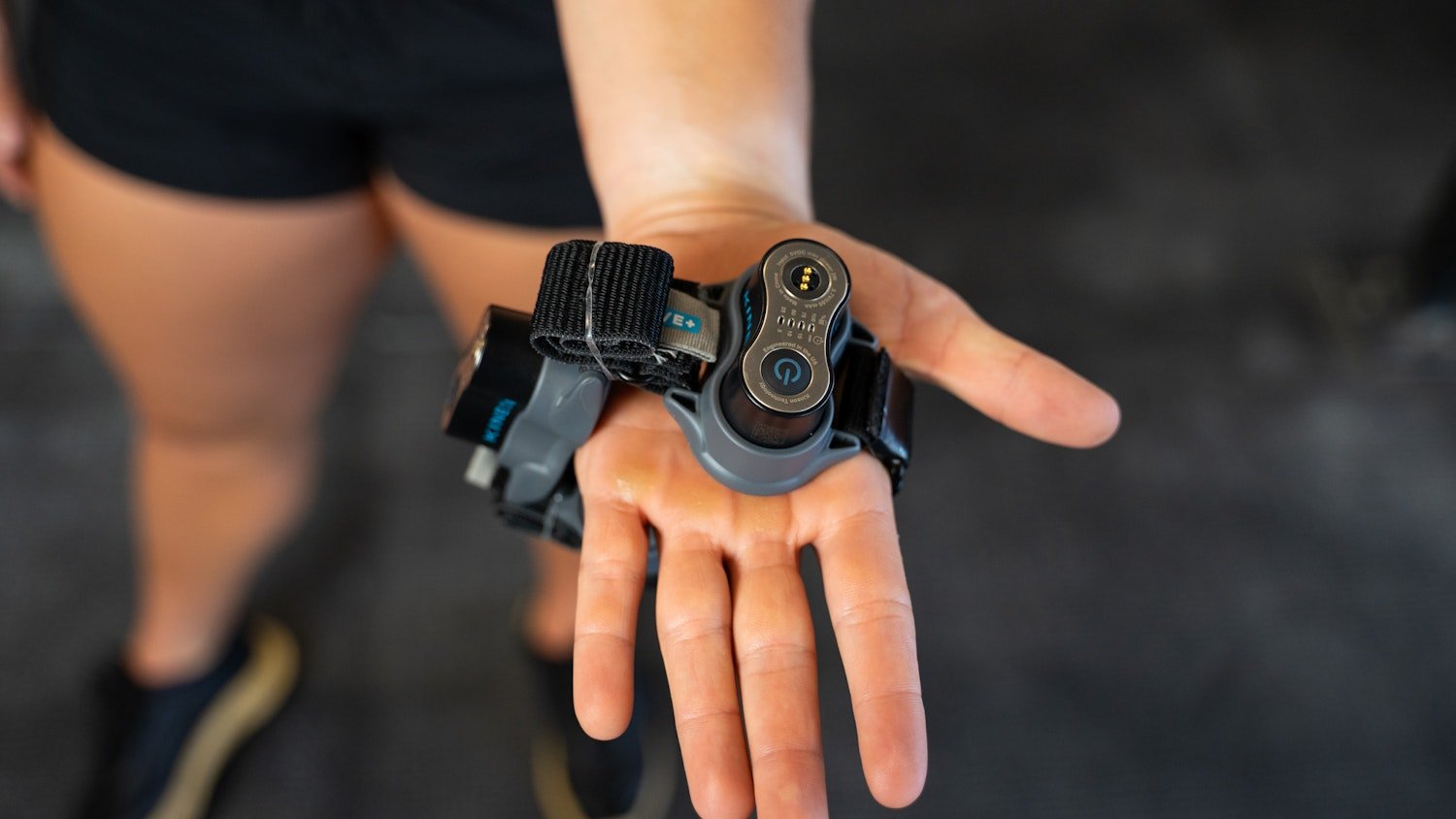
MOVE+ 2.0 is a red light therapy device intended for at-home use over the joint area. Its listed use is to reduce inflammation and to reduce joint pain. The clinical evidence above describes the research literature rather than this device.
See the MOVE+ 2.0 product page for specifications, and the knee pain guide for the condition-specific evidence.
Frequently asked questions
Is red light therapy good for arthritis?
For osteoarthritis, two independent meta-analyses found a significant reduction in pain (PMID 31662383, PMID 36576096). The benefit is dose-dependent — it appears at 4 to 8 Joules per point in the near-infrared band, and a 2015 meta-analysis that pooled studies at lower doses found no significant effect.
How long does red light therapy take to work for arthritis pain?
Trials typically run 10 to 16 sessions across four to eight weeks. That describes the usage pattern in the literature rather than a promised timeline.
What should I look for in a device for arthritis?
Wavelength in the 808 to 850nm range, coverage that reaches the whole joint, and a form factor that makes consistent use realistic across several weeks.
Can red light therapy be used alongside arthritis medication?
Studies have generally examined it as an adjunct rather than a replacement. Any change to prescribed medication is a decision for the prescribing clinician.
Does red light therapy work for rheumatoid arthritis?
The evidence is weaker than for osteoarthritis and does not all agree. A 2024 meta-analysis of 22 studies found no significant pain reduction versus placebo, but did find improved grip strength and reduced morning stiffness (PMID 39574241). A 2023 review concluded infrared laser may not be superior to sham in this condition (PMID 37683021). It should only ever be considered alongside prescribed medication, never instead of it.
Does red light therapy improve joint function as well as pain?
The evidence is weaker there. Both anchor meta-analyses found a pain benefit but no clear benefit for range of motion, muscle strength or function.